


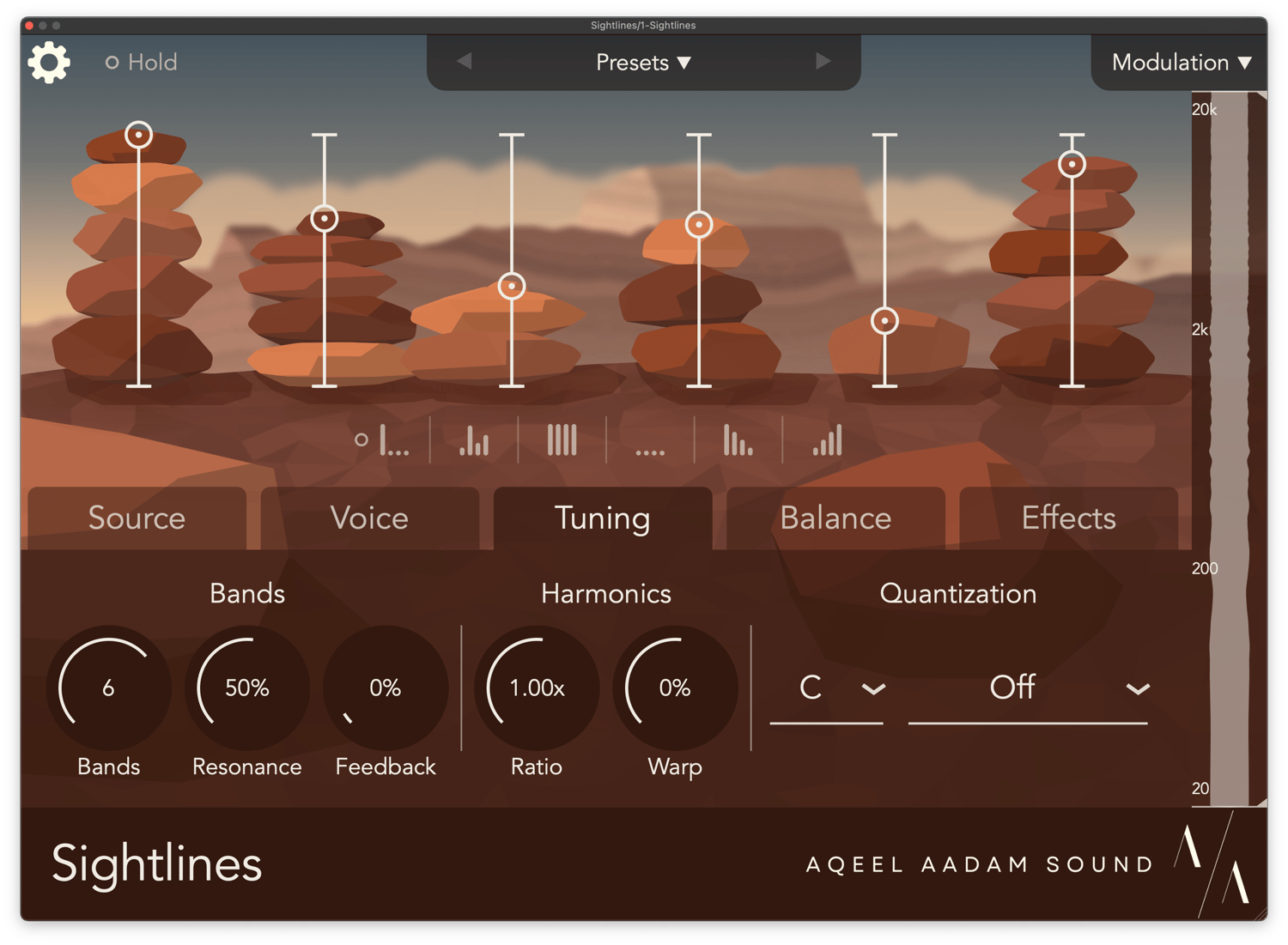
My latest plug-in, Sightlines, is available now. It’s a playable filter that can impart musicality onto unpitched sounds, or help you sculpt tonal sounds. It uses a collection of bandpass filters tuned to the harmonic series to accomplish this. You might be thinking that this sounds similar to Outgrowth’s harmonic filter – and you’d be completely right. Sightlines was actually born out of Outgrowth’s filter, and the common feedback that people wanted to go deeper with it. Sightlines is the result of taking that simple concept and exploring every avenue of it – I hope you find it as fun as it is deep.
Read on to learn more about how it works – but first I’d like to talk a bit about why Sightlines is special to me.
Sightlines is on macOS/Windows/iOS in VST3/AU/AAX/AUv3 format.
What is a filter bank?
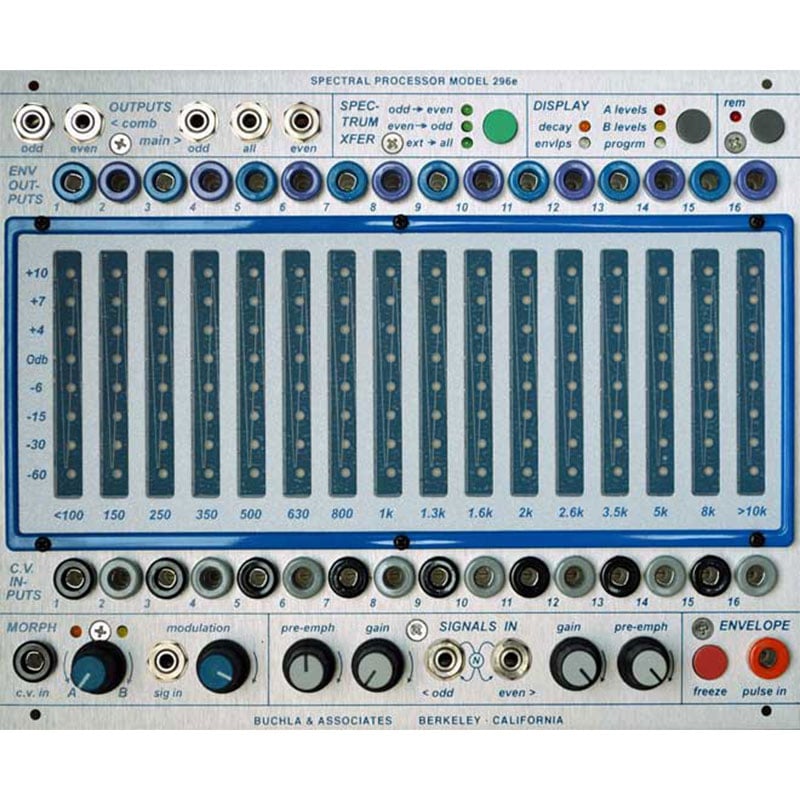
A filter bank is basically a bunch of bandpass filters. It’s akin to a graphic multi-band equalizer, but designed to be more of a musical tool as opposed to a mixing tool (though there’s certainly overlap between the two). Both of them feature bandpass filters spread across the frequency spectrum, but the main difference (to me at least) is that a filter bank can become more surgical, and even tonal, as we sharpen the resonance of the filters.
Filter banks have a rich history as very flexible and interesting (though niche) sound design tools. I have a deep fondness for the Buchla 296e Spectral Processor and the Verbos Bark Filter (which I still have in my eurorack rig to this day). There’s a particular musicality that comes from splitting a signal into narrow bands and manipulating their volume, positioning, and potentially even reacting to the volume of a particular band. Personally, I don’t often love the sound of simply sweeping a single filter around, but sweeping the volumes of a bunch of bandpass filters is *chef’s kiss*. Even more amazing is that these filters commonly let you pan each band as well, so that you can navigate the stereo field while also moving through the frequency spectrum.
I love using these in my own compositions, and probably have the Bark Filter somewhere on everything I’ve recorded off of the modular in the last few years. I love sending it atmospheres, reverbs, or percussion. The latter is super fun – sometimes I even send it raw impulses which I can sculpt into percussion, which really speaks to the power of this tool.
Big credit to my friends Yaw for making the Buchla sing and Matt for convincing me to buy the Bark Filter.
Out-growing Outgrowth
As I mentioned before, Sightlines was born out of Outgrowth’s harmonic filter. The harmonic filter was a latecomer for Outgrowth, and was only recently added in May. However, from the day of its release, I think that I and many other users found that there was much more to be explored with the concept.
The concept is pretty simple: what if we constructed a filter bank where each band was tuned to a member of the harmonic series? The result might be the best of both worlds – the magic of a filter bank combined with something akin to a harmonic oscillator (again, we must give a shoutout to Verbos here!). This filter turned Outgrowth from something primarily suited to being a pitched sample player into something that could actually impart tonality onto unpitched sounds, like field samples or noisy textures.
Outgrowth’s harmonic filter is relatively simple, which fits the ethos of that product. Outgrowth is designed to be fast, fun, and stay out of your way. In thinking about how to expand on the harmonic filter, I came to the conclusion that it was best as a separate product. There’s a ton of shared DNA between Outgrowth and Sightlines, though. Sightlines can load and play samples much like Outgrowth (just drag a sample in, and the pitch is automatically analyzed and mapped across the keyboard), but while Sightlines goes much deeper with the concept of filtering, Outgrowth goes deeper with its sampling capabilities.
A new vantage point
Enter Sightlines. In building it, I tried to balance everything I’ve learned via Aqeel Aadam Sound up to this point. It walks the line between simplicity and depth in a manner similar to Outgrowth. It blurs the line between instrument and effect in a manner similar to Coastline. Above all else, I tried to make sure it was affordable.
With Sightlines, I wanted to build out a new price tier of products in my catalog. I have a strong commitment to affordability, accessibility, and the democratization of making great music. I’ve gotten the feedback from some folks that they don’t feel comfortable taking the plunge into my catalog at the current price points, and I totally hear that. As a result, Sightlines will be $30, and just $20 at launch.
I think this price reflects a few things that I’m really proud of. I’ve learned a massive amount since starting Aqeel Aadam Sound a few years ago, and I can pull from that experience to work quicker while still maintaining the level of product excellence that I strive for. And, as I said previously, there is some intentional overlap between my previous products. I want this to feel like an optional side quest for Outgrowth owners, and an entry point that doesn’t compromise on quality for people who haven’t felt comfortable purchasing Outgrowth.
On the whole, I think Sightlines is a testament to the support I’ve received from all of you. To be candid, when I was first starting out, I couldn’t afford not charging as much as I thought that I fairly could. But after years of support from a wonderful user base, I can comfortably start to expand out the pricing tiers that Aqeel Aadam Sound can offer.
Let’s talk shop
Okay, enough chit-chat. Let’s actually break down what Sightlines can do.
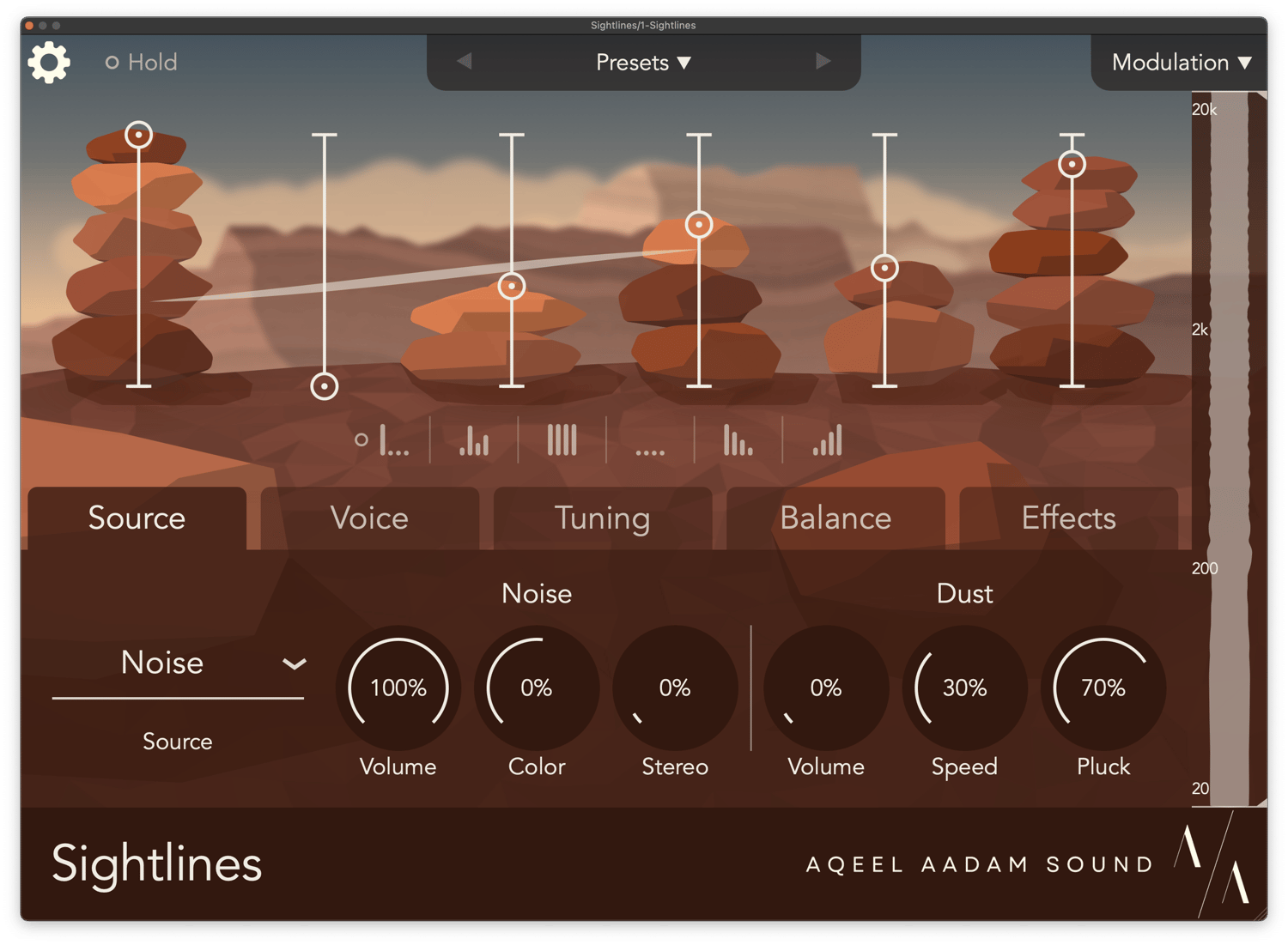
Sightlines can be loaded as an instrument or as an effect. The two versions are almost identical except for the sounds that run into Sightlines’ filters; in the effect version you simply process whatever audio is sent into it, while in the instrument version, you can load a number of sounds.
Speaking of, the instrument version features four sound sources that I think you can have a lot of fun with. To start, you can filter basic noise. You can take things one step further by loading samples as well, which can either be played and repitched based on MIDI notes (similar to Outgrowth) or looped infinitely to become a sort of noise source of their own. Sightlines loves things like found sound, impulse samples, and weird textures. You can use Sightlines to add a really unique tonality onto any of these, or you can load pitched samples to actually sculpt the harmonics of a sound.
You can also put Sightlines into synth mode, where it uses oscillators for each band rather than using filters at all (effectively, it eschews its responsibility as a filter bank, and becomes a genuine harmonic oscillator). You can use it to simply create a synth with a custom proportion of each harmonic band. For those keeping score: inside Sightlines is actually the first Aqeel Aadam Sound synthesizer, and I think you can have a lot of fun with it.
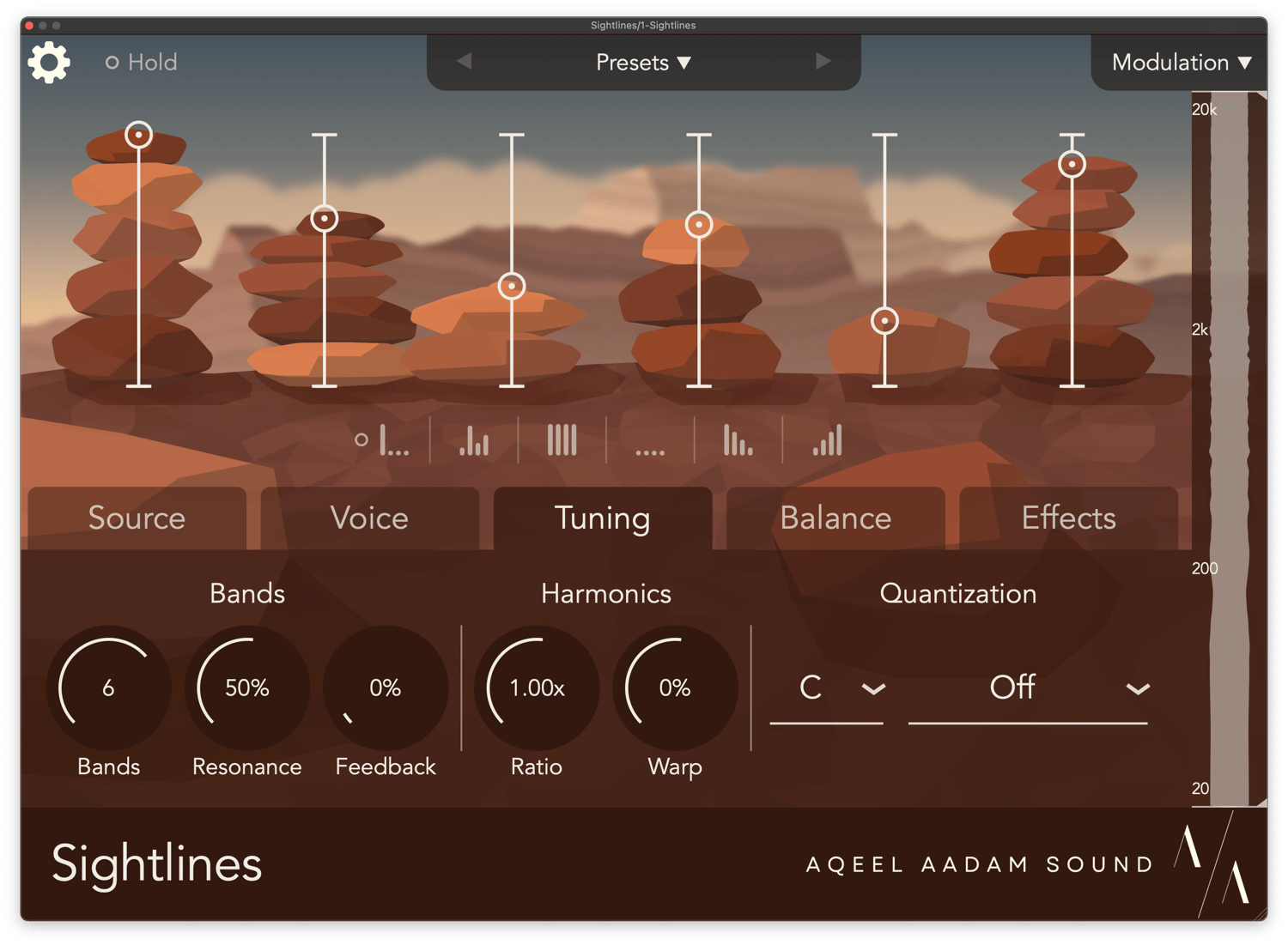
The tuning of Sightlines’ bands is based on the harmonic series, but one of the biggest upgrades Sightlines offers is the ability to actually manipulate the natural harmonic series. You can stretch, squash, or warp the familiar harmonic series of overtones that we know and love into something completely alien and never heard in nature. You can create glassy tones, gummy sounds, something completely atonal, or just a hair out of place. To be honest, this concept gets a little heady, so it might be best to see it in action in the video manual.
You can also choose to quantize the bands of Sightlines to a scale. This snaps every frequency to something more consonant, and guarantees that the highlighted frequencies will fit your scale. This is really nice if you want to, for example, impart the key of your song onto your percussion, a texture, or a riser/sound effect. It can also effectively turn Sightlines into a fun little chord synthesizer, where your collection of bands become the notes in a chord that follow every note you play.
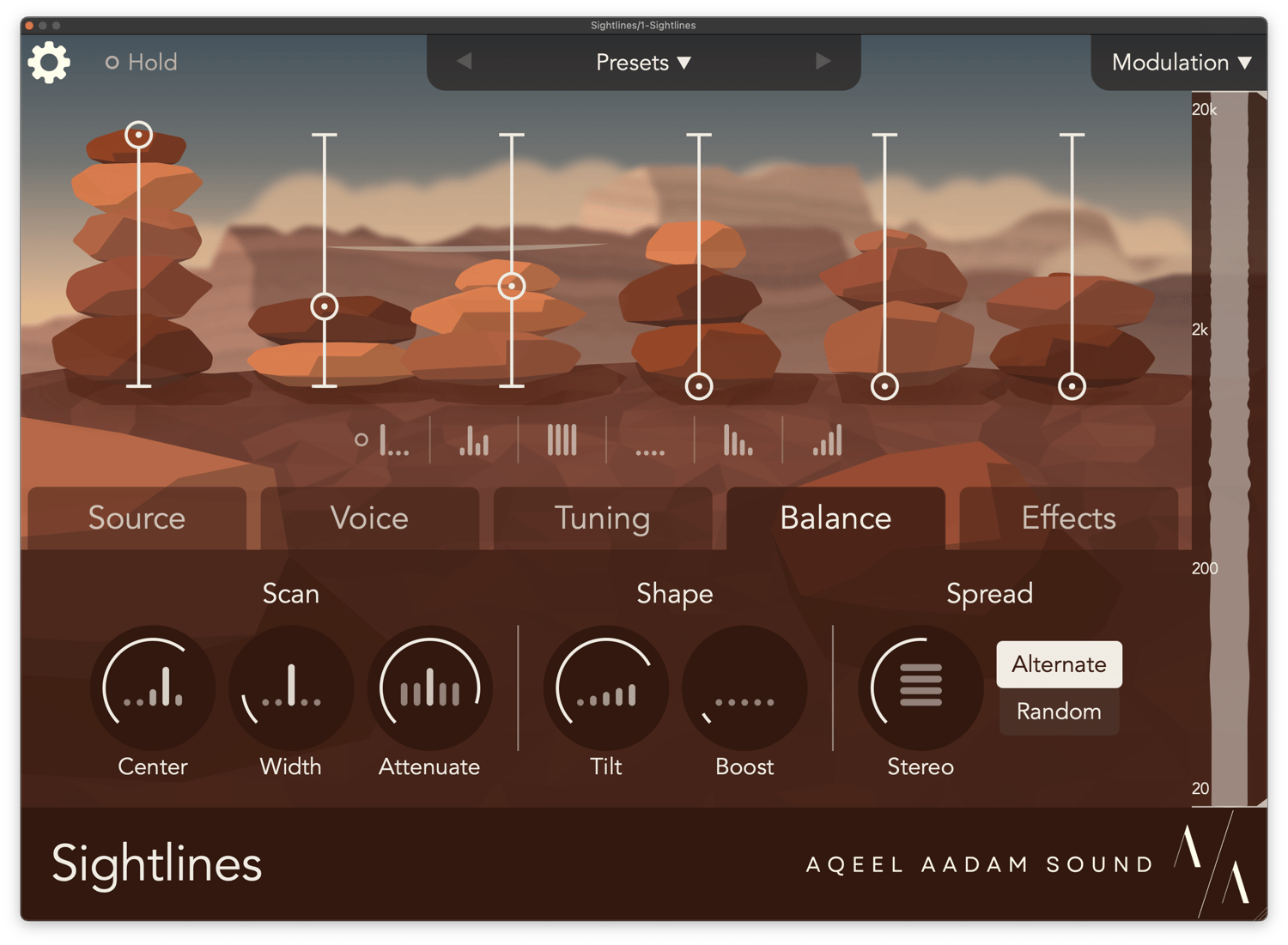
Sightlines features a ton of musical ways to manipulate the volume of the bands. Many of these ideas are adapted from the classic filter banks of old. My favorite is the ability to Scan through the bands – you can send some energy to a particular part of the spectrum, and create a really natural effect as you morph between adjacent bands with modulation or your own performance.
We can also tilt the bands towards higher or lower frequencies, boost them all, or spread them in the stereo field. These controls are all super hungry for modulation, and are really rewarding to play with. Many of the applications of these controls can be found in the factory presets, which I really tried to highlight as a jumping-off point.
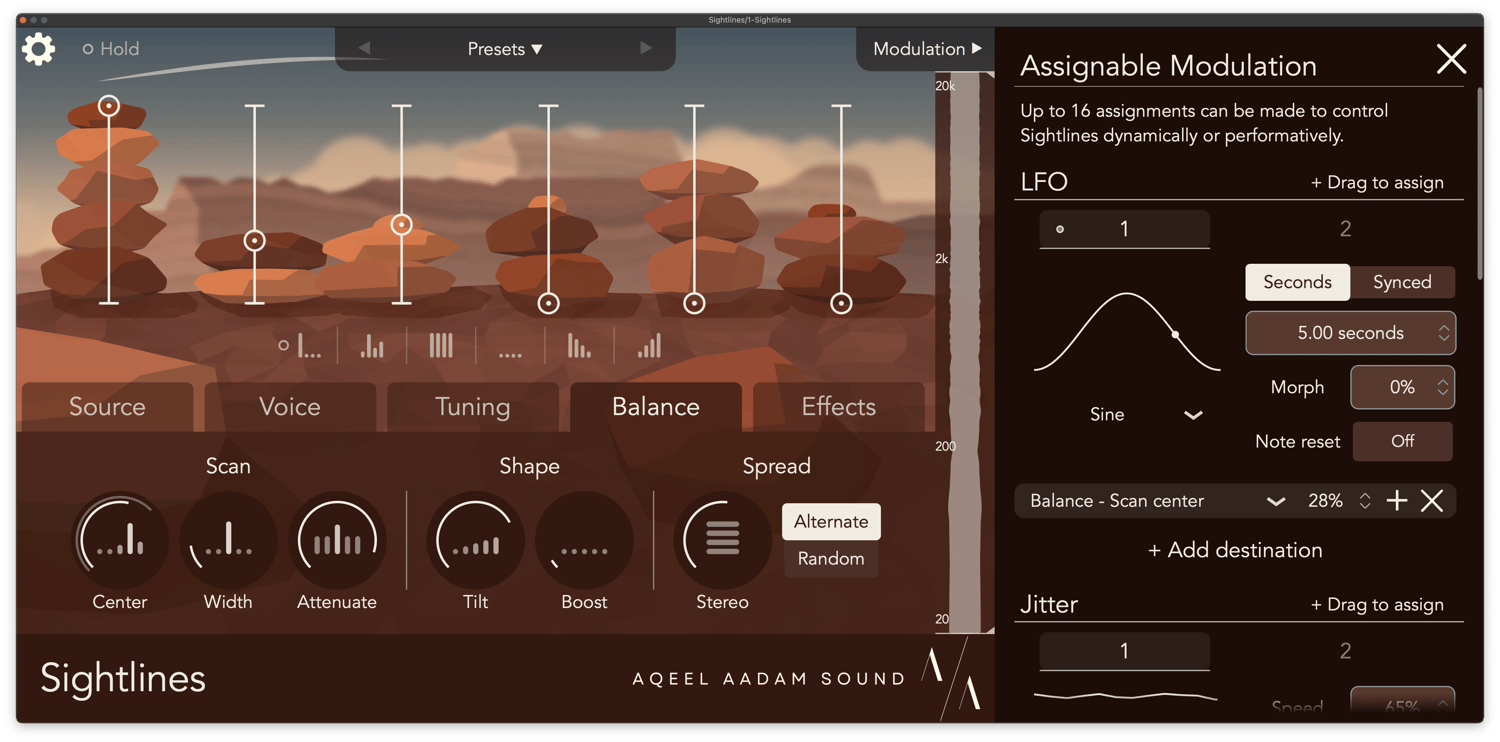
Finally, we have a suite of effects and modulation sources that can really make Sightlines shine. I’ve typically resisted the urge to add a set of end-of-chain effects to my previous plug-ins (because, let’s be honest – I’m sure you already have a reverb or delay that you’re quite fond of). I thought it was important in this case though, to complement the sonic quality of Sightlines. The output of the product tends to be relatively sine-like, due to the high resonances in play. As a result, a little chorus, delay, or reverb can really polish the result and help bring it back from the brink of total digital purity.
The modulation menu should be familiar for users of Outgrowth and Coastline. It features some of my favorite sources from both products: Outgrowth’s performance options and Coastline’s generative tools.
Onward, upward, outward
Thanks for reading this far, and thanks for continuing on this journey with me. I’ve got plenty more coming next as well that I think you’ll be very excited by. Until then, you know where to find me!